Title Bar Crystal Recovery (dot) com

NEWS & INFO


AMPHETAMINE - GO-PILLS - NEWS STORY

Go-pills, Bombs & Friendly Fire

Amina Ali, June Chua & Martin O’Malley, CBC News Jan. 14, 2003

The hearing into the case of the two U.S. pilots who bombed Canadian troops in Afghanistan will doubtless dwell on chain-of-command issues, perhaps the cowboy machismo of fighter pilots, but military chemistry – and the so-called “go-pill” – is sure to play some role in the outcome.

The pilots, Majors Harry Schmidt and William Umbach, could face a court martial for their actions, which could mean long prison terms for both men if found guilty. The “friendly fire” incident happened on April 18, 2002, when the F-16 dropped a laser-guided 225-kilogram bomb near Kandahar, accidentally killing four Canadian soldiers and injuring eight others.

Defence lawyers for the pilots have said they would argue that the forcible use of the drug dextroamphetamine (Dexedrine) – known on the street as “speed,” in the military as “go-pills” – was to blame for the incident. The lawyers use the term “forcible use,” meaning the pilots could be found unfit for the missions unless they agreed to take the pills.

Go-pills are routinely taken by pilots to keep them awake and alert on long missions. Schmidt has said he flew seven 10-hour missions in the weeks preceding the April 18 sortie and had used the go-pills each time. At the time they dropped the bomb during nighttime live-fire exercises at Kandahar, Schmidt and Umbach had been flying six hours.

Schmidt and Umbach are part of the 183rd fighter wing of the Illinois National Guard. They had been called up for active service in Afghanistan in March, about a month before the Kandahar incident. Schmidt had been trained as a top-gun fighter pilot. Umbach was a United Airlines pilot.

On the matter of go-pills, Dr. Robert DuPont, one of the leading authorities on drug addiction in the U.S., recently told ABC’s 20/20 he was shocked to learn the U.S. air force encourages, if not mandates, the use of amphetamines for its pilots. “People who get strung out on amphetamines are … usually crazy,” DuPont said. “They’re paranoid, they stop eating … Their judgment is impaired and they do very bad things … They are the sickest of all drug addicts.”

Amphetamine is known on the street as copilots, speed, zip, dexies, bennies, crosstops, uppers and crank. It has also been called the poor man’s cocaine.

Historical Use: Amphetamine was first synthesized in 1887 in Germany. It was investigated as a possible cure or treatment for ailments from depression to decongestion.

In 1919, the Japanese discovered a more potent version of the drug — methamphetamine. The new drug was a crystalline powder soluble in water. In this form, it can be smoked, injected, snorted or taken orally. Users get an intense but brief high when they inject or smoke the drug, but if it’s snorted or taken orally by capsule, the high lasts longer.

1919-1930s: In the late 1920s, scientists discovered amphetamine was good for opening the bronchial passages and stimulating the central nervous system. By the 1930s, amphetamine was marketed as Benzedrine, an over-the-counter inhaler to treat nasal congestion. The drug was used and abused by non-asthmatics. By 1937, it was available by prescription in tablet form.

By the 1930s, high-performance athletes were choosing amphetamine over strychnine as their performance-enhancing drug of choice. Amphetamine improves concentration and endurance but it also increases the risk of heat stroke because the drug causes blood to flow away from the skin. This proved fatal for some athletes.

The drug was used widely during the Second World War to keep soldiers awake and alert. American, British, German and Japanese soldiers were issued amphetamine to combat fatigue and heighten endurance.

1950s-present: By the 1950s, tablets of methamphetamine (Methedrine) and dextroamphetamine (Dexedrine) were legally manufactured and became available to the public. Truck drivers, athletes and businessmen used them. Students popped them as “pep pills” to cram for exams. Amphetamines were used as weight-control pills.

By the 1960s in the U.S., underground meth labs popped up in California. San Diego was where the drug was manufactured for pilots heading to fight the war in the Pacific. Addicts were using injectable methamphetamine all over the U.S. One of the first noticeable doping cases involving amphetamine occurred at the 1952 Winter Olympics. Several speed skaters (giving new meaning to the expression) became ill and required medical attention.

At the 1960 Olympics, Danish cyclist Kurt Jensen collapsed and died of a heart attack from an amphetamine overdose. The International Olympic Committee took action in 1967 after the death of British cyclist Tommy Simpson from amphetamine in the Tour de France. In 1968, amphetamine appeared on the IOC’s new list of banned substances.

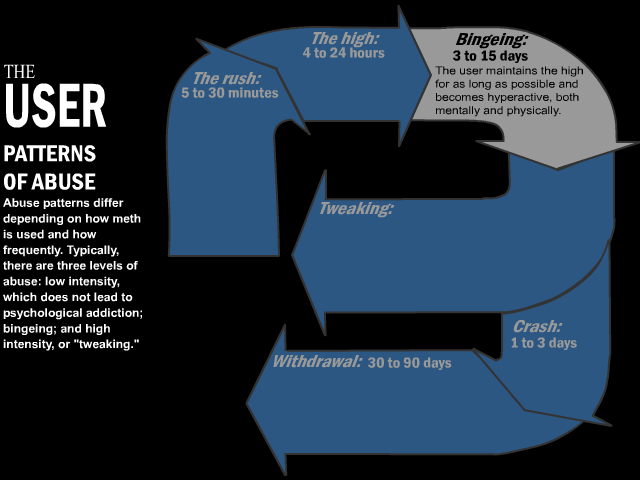
Crystal methamphetamineice, crystal, jib – started showing up in the late-1960s, when the term “Speed kills” was coined. It is clear, almost transparent in appearance. That compares to common methamphetamine, which is a white to dark brown powder or chunk with different consistencies. Crystal meth is usually smoked and produces a high that can last 24 hours.

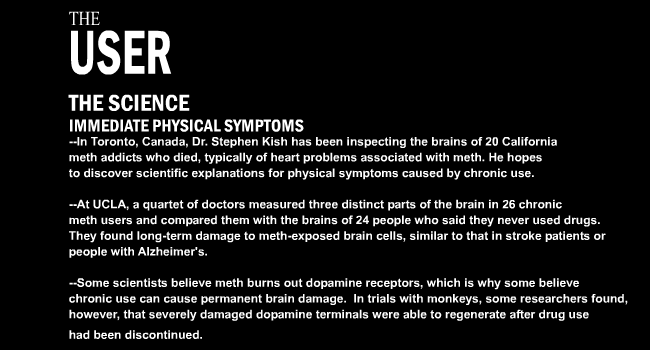
The long-term effects of methamphetamine include: chronic insomnia, paranoia, hallucinations, halted personality development, malnutrition and anti-social tendencies. Withdrawal symptoms include restlessness, mental confusion and depression.

Amphetamine and methamphetamine are stimulants. They are part of a molecule group called phenethylamines, along with hallucinogens such as mescaline, 2CB and DOM, and "entactogens" such as Ecstacsy, MDE, MDA and MBDB. Ecstacy is a methamphetamine derivative. The chemical name for Ecstasy is methylenedioxymethamphetamine, abbreviated as MDMA – the "MA" part is for methamphetamine.

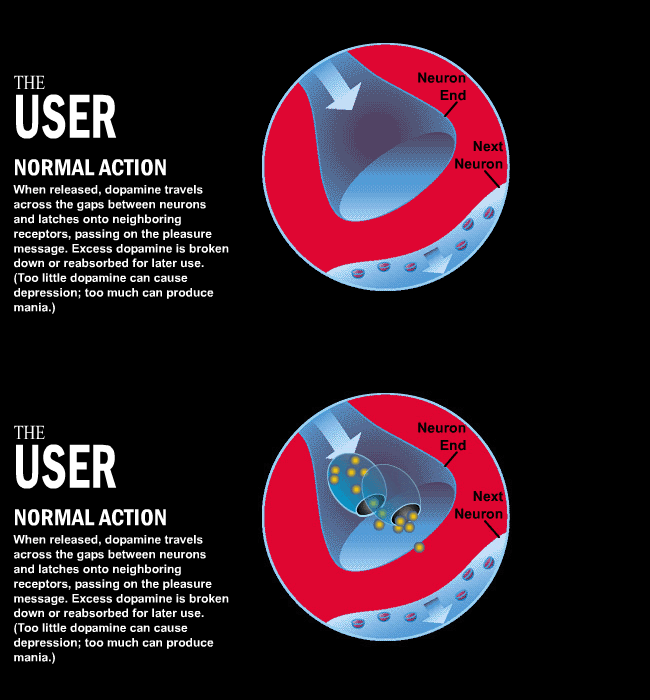
Despite their chemical similarity, MDMA and methamphetamine have different interactions in the brain. Ecstasy primarily affects serotonin, which mediates emotional systems. Methamphetamine has a greater effect on dopamine, a neurotransmitter linked to pleasure and reward.

Return to NEWS & INFO Index