Title Bar Crystal Recovery (dot) com

Treatment Improvement Protocol (TIP)


Treatment for Stimulant Use Disorders:
Methamphetamine & Cocaine - 1999
Treatment Improvement Protocol (TIP) Series 33
Center for Substance Abuse Treatment

Figures

Percentage Change 1992 to 1994
Los Angeles
68
198
219
+222
Phoenix
20
63
122
+510
San Diego
97
110
172
+77
San Francisco
48
62
69
+44
Source: DEA, 1996.

Figure 1-2: Some Street Names for Methamphetamine
Figure 1-2
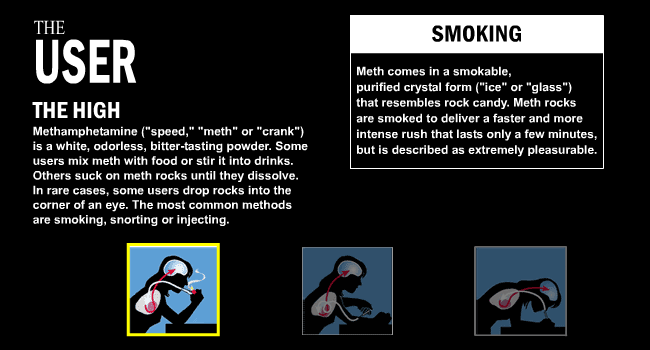
Some Street Names for Methamphetamine
*
Crank
* Crypto
* Crystal
* Crystal meth
* Meth
* Quill
* Speed
* Tweak (an MA-like substance)
* White cross
* Yellow bam
For Smokable Forms

* Cristy
* Hanyak
* Ice
* L.A. glass
* Quartz
Source: ONDCP, 1995.

Figure 1-3: 1997 Monitoring the Future Study: Drug Use Among High School Seniors
Figure 1-2
1997 Monitoring the Future Study: Drug Use Among High School Seniors

Drug
Percentage ever used
Percentage used in the past year
Percentage used in the past month
Cocaine
8.7
5.5
2.3
Stimulants
16.5
10.2
4.8
Source: NIDA, 1998b.

Figure 2-1: The Typical Neuron


Figure 2-2: Typical Synaptic Junction


Figure 2-3: The Limbic Reward System


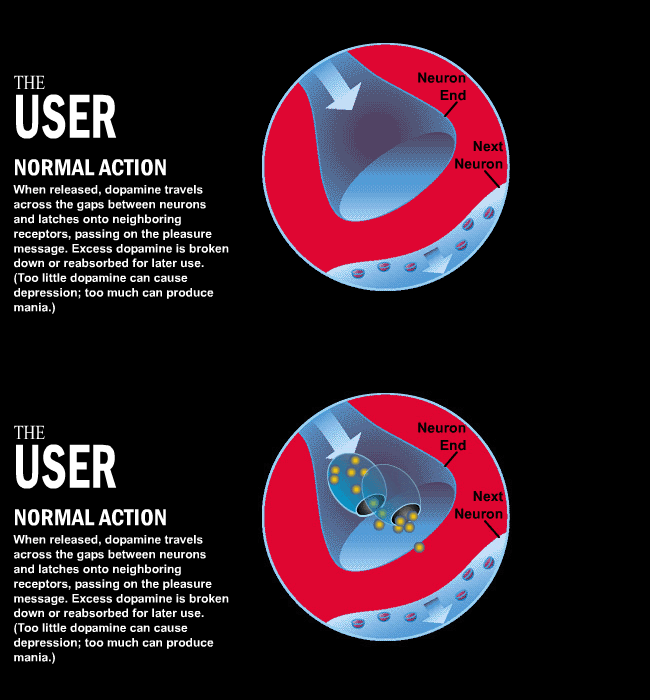
Figure 2-4: Dopamine's Normal Action


Figure 2-5: Comparison of Plasma Levels of Methamphetamine After Oral Administration and Smoking


Figure 2-6: Comparison of Plasma Levels of Methamphetamine And Cocaine After Smoking


Figure 2-7: Cocaine Blockade of the Dopamine Reuptake Transporter


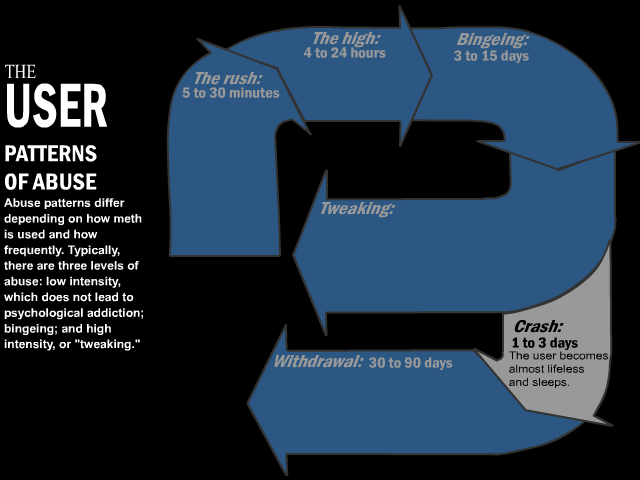
Figure 2-8: The Course of Cocaine Addiction
Figure 2-8
The Course of Cocaine Addiction
Early Stage

* Brain chemistry altered
* Addictive thinking begins
* Obsessive thoughts
* Compulsive urges
* Conditioned cravings
* Lifestyle changes
* Withdrawal from normal activities
* Subtle physical and psychological consequences (e.g., jitters, irritability, mood swings)
Middle Stage

* Loss of control
* Cravings
* Inability to stop despite consequences
* Denial
* Increasing isolation
* Increasing physical and psychological consequences (e.g., paranoia, panic seizures)
* Impaired work/school performance
Late Stage

* Failure of efforts to stop
* Severe financial problems
* Severe work/school dysfunction
* Plummeting self-esteem
* Severe relationship problems
* Chronic severe depression
* Cocaine psychosis
* Death
Source: Washton, 1989. Copyright © 1989 by Arnold Washton. Used with permission from the author.
Figure 2-9: Methamphetamine's Effects on Synaptic and Intraneuronal Dopamine Leakage


Figure 3-1: Evaluating the Matrix Model
Figure 3-1
Evaluating the Matrix Model
The Center for Substance Abuse Treatment has recently solicited applications to replicate and evaluate the Matrix 8- and 16-week protocols for the treatment of MA use disorders. This project will represent the first multisite evaluation of a specific psychosocial approach for the treatment of MA disorders. The goal of the project is to collect data on the clinical efficacy of the treatment approach, as well as cost effectiveness information on the two treatment protocols. This project is scheduled to be completed by September 2001.

Figure 4-1: Schedule Appointments Quickly
Figure 4-1
Schedule Appointments Quickly
Making an appointment within 24 hours of initial phone contact significantly increases the likelihood of showing up for an initial appointment (Festinger et al., 1995, 1996; Stark, 1992; Stark et al., 1990). Such research suggests that an accelerated intake is a low-cost and effective method of reducing the high attrition rates commonly observed between the initial clinical contact and intake interview.

Figure 4-2: Treatment Duration, Frequency, and Format
Figure 4-2
Treatment Duration, Frequency, and Format
*
Research has not yet demonstrated the optimal duration, frequency, and format of treatment for stimulant addiction (Higgins and Wong, 1998). Some research suggests that longer treatment durations of 6 or 12 months are associated with better outcomes for cocaine-dependent individuals (Carroll et al., 1993a; Higgins et al., 1993a; Wells et al., 1994), but the research is not consistent and has not evaluated MA treatment.
* Experience suggests that the duration of the initiating treatment is a minimum of several weeks. Most stimulant-dependent clients require 2 to 4 weeks to establish an initial period of abstinence and to overcome certain cognitive impairments. It is common for programs to encourage frequent visits during the first 2 to 4 weeks of treatment followed by less frequent visits.
* For clients with stimulant use disorders during this phase, the frequency of visits or sessions seems to be more important than their length. For example, three or four weekly visits of approximately 30 minutes appear to be more beneficial than fewer weekly visits that last longer. There is no evidence that clinic visits lasting more than 90 minutes are more effective than shorter visits. The greater frequency of clinic visits can help to establish behavioral accountability, contain impulses, and create daily structure.
* In practice, the most common format for stimulant use disorder treatment is group rather than individual therapies. Experience suggests that stimulant-dependent clients are capable of full participation in group-oriented therapies, although their low tolerance for frustration may make lengthy group sessions onerous. However, clients who are still paranoid and distrustful of others may not be willing to participate in group therapy, but may be willing to participate in individual counseling as an initial strategy and bridge into group treatment.

Figure 4-3: Basic Conditioning Factors in Stimulant Use
Figure 4-3
Basic Conditioning Factors in Stimulant Use
*
Stimulant cravings are the predictable results of chronic stimulant use and typically continue long after the stimulant use is stopped.
* Stimulant cravings can be triggered by people, places, situations, things, and feelings that were previously associated with stimulant use. Anything that reminds clients of stimulant use can be a trigger for stimulant cravings.
* Stimulant cravings are typically strong during the early abstinence period and become less frequent and severe over time. They lose their power only when not reinforced by stimulant use.
* The strength of cravings does not diminish merely through the passage of time but because clients do not give into to the cravings when they occur.
* Complete abstinence from all psychoactive drugs is the best way to ensure the most rapid and complete extinction of stimulant cravings.
* Determination and willpower are poor defenses against cravings. Rather, specific actions must be taken to counteract cravings and urges whenever they occur.
* Cravings and urges are always temporary. They are usually fleeting sensations lasting no more than a few minutes and tend to disappear quickly when immediate action is taken to remove oneself from the situation that has prompted the craving.
Source: Adapted with permission from Washton, 1989, p. 107.

Figure 4-4: Related Research: Behavioral Relationship Therapy
Figure 4-4
Related Research: Behavioral Relationship Therapy
A review of research evidence regarding behavioral relationship therapy and substance use disorder treatment outcomes (Landry, 1995) noted that

* Behavioral relationship therapy can improve the quality of interpersonal relationships, promote rapid reductions in substance use, enhance maintenance of sobriety, enhance treatment outcomes, and decrease the probability of treatment dropout. Relationship therapy both during and following treatment improves treatment outcomes.
* Spouse involvement in treatment yields better results than treatment without spouse involvement. Unilateral treatment of the spouse with the person with the substance use disorder has been found to increase the client's motivation for treatment.
Similarly, a meta-analysis of controlled studies that compared family therapy with other therapy approaches to substance use disorder treatment (Stanton and Shadish, 1997) noted that

* Family therapy was more effective and had higher retention rates than individual counseling or therapy, peer group therapy, and family psychoeducation.

Figure 4-5: Responding to Slips in Group Sessions
Figure 4-5
Responding to Slips in Group Sessions
*
Ask the person to provide a detailed account of the sequence of feelings, events, and circumstances that led to the slip.
* Encourage group members to ask the person for further details, and to help him identify early warning signs and self-sabotaging behaviors.
* Encourage group members to state their concerns for the individual.
* Encourage group members to offer advice and recommendations about preventing further slips.
* Ask the person to discuss his thoughts and feelings about what has been said in the group and what he intends to do differently.
Source: Washton, 1990a.

Figure 4-6: Addressing Relapse
Figure 4-6
Addressing Relapse
An integral aspect of relapse prevention involves eliminating and correcting dangerous myths and misconceptions regarding the process of relapse and the appropriate treatment response to it. The Consensus Panel recommends that the following concepts be incorporated into educational efforts for clients, counselors, and nonclinical staff members.

* Relapse is not necessarily a sign of poor motivation. Although relapse can be a sign of extreme ambivalence or poor motivation to quit using stimulants, even the most highly motivated and sincere clients can relapse. Relapse is a sign that something is wrong with the client's recovery plan, not with the client.
* Relapse is not a sign of treatment failure. It is a temporary interruption in the client's abstinence. It means that the client's recovery plan is incomplete and is a signal that the client is doing something that he shouldn't do, or that the client should be doing something that he isn't.
* Relapse is predictable and avoidable; rarely is it unpredictable. It is preceded by warning signs that the counselor and client should be trained to identify. It is the endpoint of a progression of attitudes and behaviors. It is interruptible and preventable.
* Relapse is not a single event invariably involving drug use. Rather, relapse is a process, as is addiction, treatment, and recovery. It has a beginning, a midpoint, and an end. Returning to drug use is the endpoint, not the beginning of the process.
* Relapse does not erase positive recovery changes. Clients need not "start over" but should avoid further drug use, remain in treatment, resume the recovery process where last left off, and enhance the treatment plan to avoid future relapses. A temporary setback can provide invaluable information about weaknesses in the treatment plan and suggest ways to prevent it from recurring in the future.
* The absence of relapse does not guarantee successful recovery. Abstinence is an opportunity to recover but is not a guarantee of recovery. Many clients who experience relapse make tremendous strides in personal growth and maturity, although some clients with uninterrupted abstinence never experience substantial changes or achieve lasting growth. Abstinence is an important first step in the recovery process but is not the final goal.
Source: Adapted with permission from Washton, 1989.
Figure 4-7: Recommendations for Running a Relapse Prevention Group
Figure 4-7
Recommendations for Running a Relapse Prevention Group
*
A relapse prevention group is a forum for clients to create a program of recovery and relapse prevention. The group provides a setting for sharing information about relapse and relapse prevention and spotting signs of impending relapse. Clients heading toward relapse can be redirected, whereas those who are on a good course can be encouraged. The group setting allows for mutual client assistance within the guiding constraints of the group leader.
* A group can be led by a therapist group leader and a recovering coleader. Ideally, the group leader also sees group members for individual sessions. The group leader must be clearly, actively, and unquestionably in control of the group and is responsible for setting the time limits and ensuring that all group members have opportunities to speak. The coleader can answer questions about and be an example of long-term sobriety.
* The group meeting begins with an introduction of new members, who are asked to give a brief history of their drug use.
* Following introductions, the group leader gives a casual and didactic presentation on a specific topic for approximately 15 minutes and/or presents an equally brief video.
* Next, relapse and recovery are discussed among the group members for approximately 45 minutes.
* For the next 30 minutes, the group leader elicits from the group members any recent problems that they want to discuss. Quiet and uncommunicative members are encouraged to talk about how they are feeling.
* At the end of the group session, the group leader ties up loose ends and summarizes the discussion. Unresolved issues may be acknowledged, and discussions can be carried over to the next scheduled meeting. Clients who appear troubled, angry, or depressed, and those who mentioned cravings can be asked to remain. The group leader and coleader can encourage such individuals to speak with their therapist as soon as possible. All sessions should end with a confidentiality pledge and a commitment to attending the next group session.
Adapted, with permission. The Matrix Center, Inc. The Matrix Intensive Outpatient Program Therapist Manual. Los Angeles: Matrix Center, Inc., 1995.

Figure 4-8: Related Research: Disulfiram Therapy
Figure 4-8
Related Research: Disulfiram Therapy
An uncontrolled study by Higgins et al. (1993a) noted that supervised disulfiram therapy was associated with significant decreases in alcohol and cocaine use among outpatients with cocaine-related disorders. A subsequent controlled trial by Carroll et al. (1993b) provided support that disulfiram therapy can reduce cocaine and alcohol use in outpatients who use both substances.

Figure 4-9: Related Research: Alcoholics Anonymous (AA)
Figure 4-9
Related Research: Alcoholics Anonymous (AA)
A comprehensive review of the research on AA reveals several important findings:

* Research demonstrates a strong association between AA participation that occurs during or following professional treatment and improvements in drinking behaviors and abstinence.
* Research suggests a strong association between increased frequency in attending AA meetings and improvements in drinking behavior measures, such as abstinence and decreases in alcohol consumption.
* Research suggests a modest association between increased participation in and affiliation with AA (such as obtaining or becoming a sponsor) and improvements in drinking behavior measures, such as abstinence, decreased drinking, and decreased relapse.
* Research suggests modest associations between AA participation and improvements in several areas of psychosocial functioning.
Source: Landry, in press.

Figure 5-1: Effects of Route of Administration for Cocaine and MA
Figure 5-1
Effects of Route of Administration for Cocaine and MA

Route of Administration
Form of Drug
Onset of Action for Cocaine and MA
Duration of "High"

Oral
Powder/pill
10 to 30 minutes 45 to 90 minutes for cocaine
3 to 5 hours for MA

Intranasal
Powder
3 to 5 minutes 10 to 20 minutes for cocaine

Intravenous
Solution
5 to 10 seconds 10 to 20 minutes for cocaine
4 to 6 hours for MA

Inhalation
Crack cocaine/Ice (MA)
5 to 10 seconds 5 to 20 minutes for crack
8 to 24 hours for ice
Sources: Cook, 1991; Gold, 1997; Gold and Miller, 1997; Sowder and Beschner, 1993.

Figure 5-2: Dose Frequency Escalation Patterns, Cocaine and Amphetamine


Figure 5-3: Differences Between Cocaine and MA
Figure 5-3
Differences Between Cocaine and MA

Cocaine
MA
*
Plant-derived
* Smoking produces a high that lasts 20 to 30 minutes
* Is eliminated from the body in 1 hour
* Used as a local anesthetic in some surgical procedures
* Man-made
* Smoking produces a high that lasts 8 to 24 hours
* Is eliminated from the body in 12 hours
* Limited medical use
Source: NIDA, 1998a.

Figure 5-4: Common Signs and Symptoms of Acute Stimulant Intoxication
Figure 5-4
Common Signs and Symptoms of Acute Stimulant Intoxication

Physiological
Psychological/Behavioral
*
Dilated pupils
* Diaphoresis (profuse sweating)--often with chills
* Hypertension (elevated blood pressure)
* Tachycardia (increased heartbeat), with or without arrhythmia and chest pain
* Bradycardia (slowed heart action)
* Hyperthermia (elevated temperature)
* Suppressed appetite, weight loss
* Bruxism (teeth grinding)
* Insomnia or decreased need for sleep
* Tremors
* Seizures--mostly for cocaine users
* Headache--occasionally
* Euphoria, heightened sense of well being
* Increased vigor, giddiness, and sense of enhanced mental acuity and performance
* Agitation, restlessness, irritability
* Garrulousness, with pressure of speech, flight of ideas, and rapid shifts in thinking
* Poor concentration
* Grandiosity, exaggerated self-esteem, egocentricity
* Hypervigilance, with increased curiosity about the environment
* Enhanced sensory awareness
* Fearlessness, suspiciousness
* Impaired judgment, poor impulse control
* Clear sensorium, not usually disoriented
* Aggression and emotional lability, with potential for violence
Figure 5-5: Common Signs and Symptoms of Stimulant Withdrawal/Abstinence Syndrome
Figure 5-5
Common Signs and Symptoms of Stimulant Withdrawal/Abstinence Syndrome

Physiological
Psychological/Behavioral
*
Thin, gaunt appearance with reported weight loss or anorexia
* Dehydration
* Fatigue and lassitude, with lack of mental or physical energy
* Dulled sensorium
* Psychomotor lethargy and retardation--may be preceded by agitation
* Hunger
* Chills
* Insomnia followed by hypersomnia
* Dysphoric mood--that may deepen into clinical depression and suicidal ideation
* Persistent and intense drug craving
* Anxiety and irritability
* Impaired memory
* Anhedonia--loss of interest in pleasurable activities
* Interpersonal withdrawal
* Intense and vivid drug-related dreams

Figure 5-6: Common Symptoms of Chronic Stimulant Abuse/Dependence
Figure 5-6
Common Symptoms of Chronic Stimulant Abuse/Dependence

Physiological
Psychological/Behavioral
*
Extreme fatigue--with physical and mental exhaustion and disrupted sleep patterns
* Nutritional disorders--extreme weight loss, anemia, anorexia, cachexia (body wasting)
* Poor hygiene and self-care
* Skin disorders and secondary skin infections--itching, lesions, hives, urticaria
* Hair loss
* Muscle pain/tenderness--may indicate rhabdomyolysis
* Cardiovascular damage--from toxicity and contaminants in MA production, with concomitant renal and hepatic problems
* Hypertensive crises with renal damage from sustained hypertension
* Difficulty breathing--may reflect pulmonary edema, pneumonitis, obstructive airway disease, barotrauma, and other complications
* Myocarditis, infarcts
* Headaches, strokes, seizures, vision loss
* Choreoathetoid (involuntary movement) disorders
* Impaired sexual performance and reproductive functioning
* Cerebrovascular changes, including evidence of cerebral hemorrhages and atrophy with associated cognitive deficits
* Ischemic bowel, gastrointestinal complaints
* Paranoia with misinterpretation of environmental cues; psychosis with delusions, and hallucinations
* Apprehension--with hopelessness and a fear of impending doom that resembles panic disorder
* Depression--with suicidal thinking and behavior
* Acute anxiety
* Eating disorders

Figure 5-7: Distinctive Indicators of Chronic Abuse of Cocaine Versus MA
Figure 5-7
Distinctive Indicators of Chronic Abuse of Cocaine Versus MA

Cocaine
MA
*
Nasal perforations and nose bleeds among snorters
* Serious constipation due to dehydration and insufficient dietary fiber
* Dental problems, including missing teeth, bleeding and infected gums, dental caries
* Muscle cramping related to dehydration, with low magnesium and potassium levels
* Dermatitis around the mouth from smoking hydrochloride salt
* Stale urine smell due to ammonia constituents used in manufacturing MA
* Various dermatologic conditions, including excoriated skin lesions

Figure 5-8: Recommended Approaches for Reducing the Risk of Violence
Figure 5-8
Recommended Approaches for Reducing the Risk of Violence
*
Keep the client in touch with reality by identifying yourself, using the client's name, and anticipating concerns.
* Place the client in a quiet, subdued environment with only moderate stimuli. Ensure sufficient space so that the client does not feel confined. Have the door readily accessible to both the client and the interviewer, but do not let the client get between the interviewer and the door.
* Acknowledge agitation and potential for escalation into violence by reassuring the client that you are aware of his distress. Ask clear simple questions, tolerate repetitive replies, and remain nonconfrontational.
* Foster confidence by listening carefully, remaining nonjudgmental, and reinforcing any progress made.
* Reduce risk by removing objects from the room that could be used as weapons and discreetly ensuring that the client has no weapons.
* Be prepared to show force if necessary by having a backup plan for help and having chemical and physical restraints immediately available.
* Train all medical or emergency staff to work as a team in managing an aggressive, paranoid, and potentially violent client.

Figure 5-9: Client Consent Form: Required Items
Figure 5-9
Client Consent Form: Required Items
*
Name or general description of the program(s) making the disclosure
* Name or title of the individual or organization that will receive the disclosure
* Name of the client who is the subject of the disclosure
* Purpose of or need for the disclosure
* How much and what kind of information will be disclosed
* A statement that the client may revoke the consent at any time, except to the extent that the program has already acted in reliance on it
* Date, event, or condition on which the consent form expires, if not previously revoked
* Signature of the client (and, for minors in some States, her parent or legal guardian)
* Date on which the consent is signed


TIP: Chapter Listing